
When we think about great teaching, we often picture the magic moments: a student finally “gets it”, the class leans in during a rich discussion, or everyone loses track of time because the learning just clicks.
Those are Flow moments — where challenge meets skill, focus tightens, and learning becomes effortless.
But here’s the secret ingredient behind creating those moments on purpose, not by accident:
LXD — Learning Experience Design.
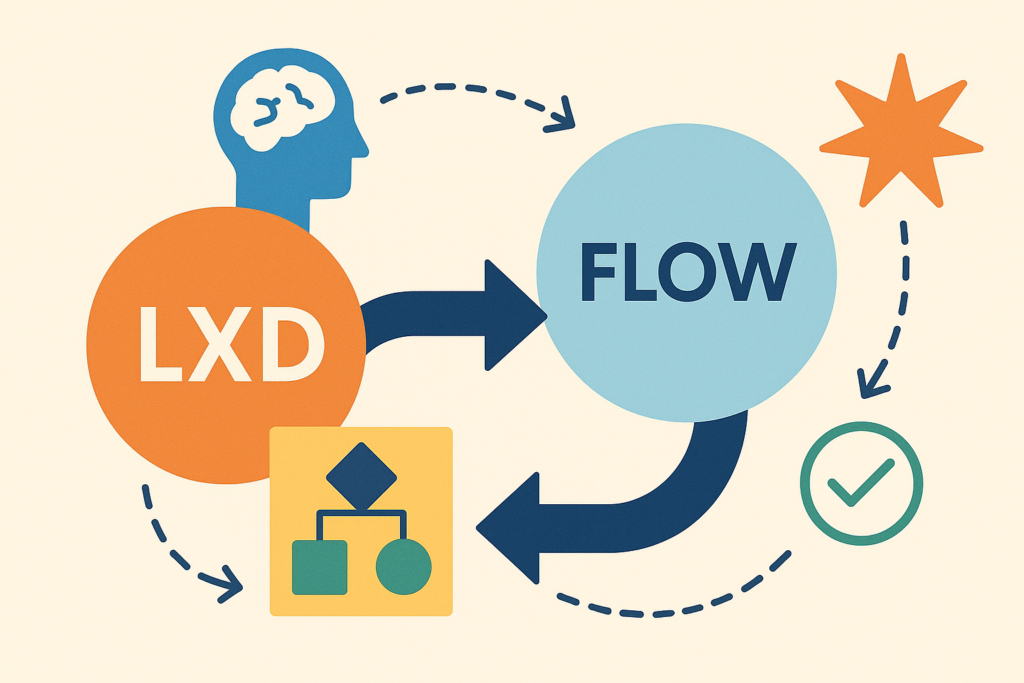
If Flow is the state, LXD is the architecture that makes that state possible.
Let’s break it down in a way that actually makes sense for busy teachers.
What Exactly Is LXD?
LXD is like UX design for the brain — the thoughtful art of designing learning journeys that are intuitive, motivating, and deeply effective.
Instead of asking:
“How do I deliver this content?”
LXD asks:
“What does the learner need to experience so this sticks for life?”
It blends:
- cognitive science
- instructional design
- psychology
- storytelling
- user experience (UX) design
- and yes… a dash of good old-fashioned teacher intuition
The result?
Learning that feels natural, engaging, and tailored to human attention, not to a rigid curriculum layout.
Why LXD Matters More Than Ever
Students today live in a world where everything competes for their attention — apps, videos, games, TikTok, Snapchat, Fortnite, you name it.
If learning is going to compete, it needs to feel:
- meaningful
- responsive
- challenging (but not overwhelming)
- personalised
- and genuinely rewarding
Good LXD creates that environment.
It turns passive lessons into experiences, worksheets into missions, and isolated tasks into flow-inducing learning arcs.
The Relationship Between LXD and Flow
Flow Theory (Mihaly Csikszentmihalyi) tells us that learners enter Flow when:
- The challenge matches their skill level
- Goals are clear
- Feedback is immediate
- The experience feels purposeful and rewarding
Guess what?
These are the exact outcomes LXD is intentionally built to produce.
Here’s how the pieces lock together:
1. Challenge–Skill Balance → Adaptive Tasks
LXD designs pathways where students can choose the right challenge for them.
Not too easy. Not too hard.
Flow loves that.
2. Clear Goals → Clear Learning Pathways
Every great learning experience starts with:
- “What are we learning?”
- “Why does it matter?”
- “How will I know I’m doing it right?”
LXD bakes this clarity into the design of lessons, apps, and activities.
Flow thrives on clarity.
3. Immediate Feedback → Smart Scaffolding
When students know instantly whether they’re on-track, the brain lights up.
It stays engaged. It adjusts. It tries again.
LXD uses:
- guided practice
- modelling
- instant corrective prompts
- AI-powered feedback (yes — Flow21 does this bit beautifully)
All of this primes the learner for Flow.
4. Autotelic Motivation → Meaningful Progress
Flow isn’t just about achievement — it’s about feeling rewarded by the process itself.
LXD builds in:
- progress arcs
- micro-wins
- streaks
- reflection loops
- curiosity triggers
These make learning feel satisfying in the moment, not just at the end.
How Flow21 Brings LXD + Flow Together
Flow21 is built on the idea that learning should feel like:
- exploration, not instruction
- choice, not coercion
- personalised challenge, not one-size-fits-all tasks
- growth, not grading
Our multi-agent AI system acts like a team of support staff inside the learning experience:
- a coach
- a tutor
- a project manager
- a feedback engine
- a motivation guide
Each agent works behind the scenes to maintain:
- clarity
- challenge–skill balance
- feedback
- momentum
That’s how Flow emerges — not by accident, but by design.
Why This Matters for Teachers
Teachers don’t need more admin.
They need more time to actually teach.
Good LXD:
- reduces cognitive overload for students
- reduces planning load for teachers
- increases learning retention
- boosts engagement and motivation
- makes the classroom flow more smoothly
And with tools like Flow21, you get an ally that helps design and deliver these learning experiences automatically.
Think of it as:
Good pedagogy meets smart technology meets human psychology.
It’s the future of teaching — and teachers deserve tools that make that future easier, not harder.
Final Thought
Flow doesn’t happen by luck.
It happens when learning is carefully crafted to match how human brains actually learn best.
That’s what LXD brings.
And that’s what Flow21 was built to deliver.